Leash · 0–8 ft waves
Future Leash
€69,00
incl. VAT · free EU shipping

Surf · Leash & traction
Your leash is the only connection to your board. We rebuilt it from scratch: metal-free, Dyneema®, built to last.

 Future Leash
6 · 7 · 9 ft · €69,00 incl. VAT
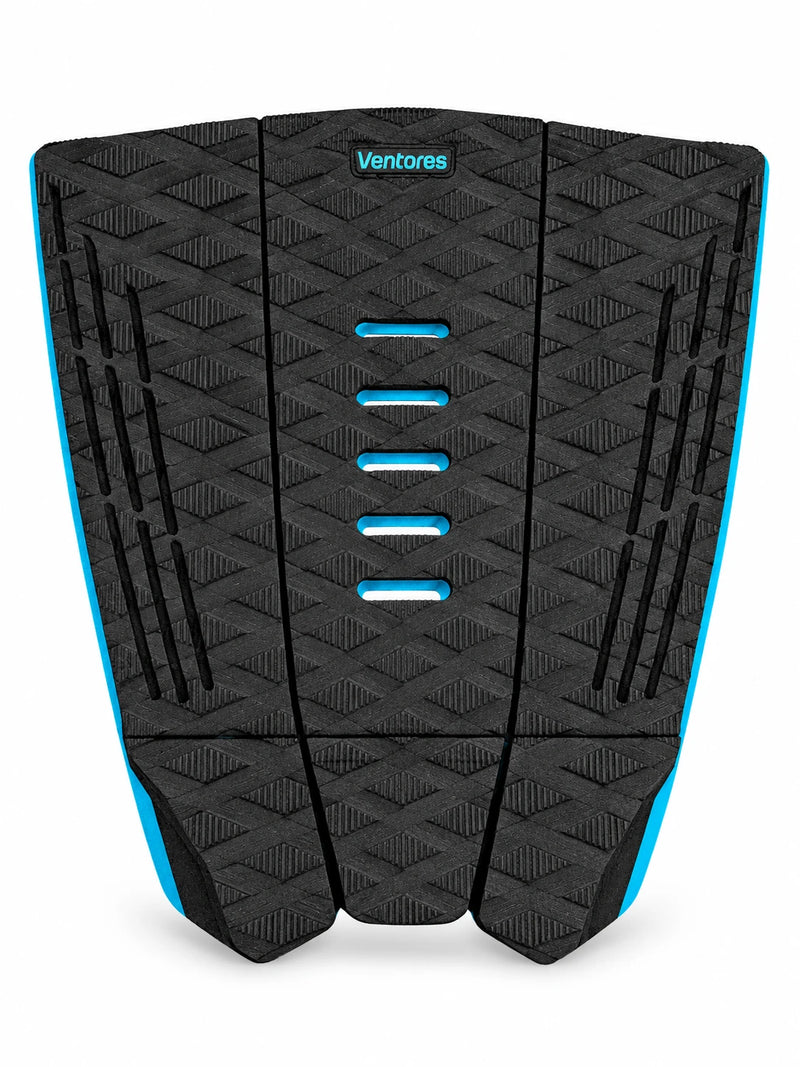
Traction PadComing soon
[01]Your surf kit
Pick your length, add it to the cart, or open the product page for every detail.
Leash · 0–8 ft waves
Coming soon
[02]Why we built it
Leashes are treated as cheap, disposable accessories. We looked at why, part by part.
Surf leashes rely on design principles that are more than 30 years old, with little innovation in materials or construction. All leashes are more or less the same.
Standard leashes frequently fail at the cord, the swivel and the attachments.
UV, salt, cuts and corrosion wear them down, so they need replacing again and again.
Surfers expect their leash to break. It is sold as a low-value throwaway accessory, built on outdated technology and accepted failure.
Bigger boards and heavier waves call for thicker cords of 5 to 9 mm to avoid breakage. Thicker means more drag and more weight.
Typical leashes are one-piece products: if any part fails, the whole leash is replaced. That adds cost and unnecessary waste.

Our answer
We analysed the whole connection between surfer and board and re-engineered every structural weak point, together with BASF partners, the University of Hamburg and a German rope maker.
[03]When it counts
After a wipeout, in a strong current or when you are tired, your surfboard is what keeps you safe out there.
It keeps you on the surface.
It makes you easier to spot.
It gets you back out or back in.
The leash is the only connection to it. If the leash breaks, you lose the board, and with it your safety. One broken cord or swivel can quickly turn into a very dangerous situation.
That's why we re-engineered every link of this connection, so you can trust it when it matters.
A leash is not a rescue device and does not replace swimming ability, knowledge of the sea and currents, or common sense.

[04]Surf leash guide
Rule of thumb: your leash should be about as long as your board.
| Leash | Board length | Board types |
|---|---|---|
| 6 ft | up to 6'6" | Shortboards, fish, grovelers |
| 7 ft | 6'6" – 7'6" | Hybrids, fish, mid-lengths, short funboards |
| 9 ft | 7'6" – 9'6" | Funboards, mini-mals, mid-lengths from 7'6", longboards |

“This leash is so reliable and light! It's held up in solid surf, giving me total confidence!”
Mentawai · Siargao · Sri Lanka · Canary Islands · Hawaii · Cape Town
[06]Surf questions
About as long as your board: 6 ft up to 6'6", 7 ft from 6'6" to 7'6", 9 ft from 7'6" to 9'6". Between two sizes, take the longer one.
Not with the Future Leash: it is rated for waves from 0 to 8 ft with a thin 5.8 mm Dyneema® cord. In overhead surf, choose one size longer.
Metal swivels and screws corrode and jam with salt and sand. The SoftSwivel works without metal, screws or glue.
No. A leash is not a rescue device and does not replace swimming ability, knowledge of the sea and currents, or common sense.
[07]Other disciplines